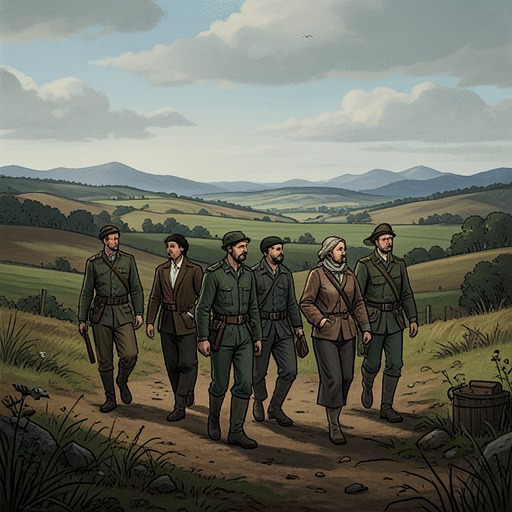
Evan’s confinement in a Tunisian desert prison
The Reincarnationist PapersEvan Michaels’s confinement in a Tunisian desert prison turns his flight from capture into an extended condition of isolation, punishment, and uncertainty. Moved across jurisdictions and sentenced twice for refusing to help recover The Rendezvous, he loses access to outside support and is left to make sense of his imprisonment from inside cell 145. The confinement becomes not only the setting for his manuscript but also the pressure under which his hope and sense of self steadily erode.
Transfer and Legal Process
After his arrest, Evan is taken from an airport holding cell to a Swiss detention facility in downtown Zurich, within walking distance of the Hotel St. Germain. He initially treats this as an early indication of what awaits him, but the conditions to come make even that first detention seem less severe by comparison. His route leads through Italy and then back to Tunisia, each stop marking a further loss of control over where he will be held and what will happen to him.
In Tunis, a brief hearing in a side room of the city jail ends with a twenty-five-year sentence and no possibility of parole. The proceedings are conducted in Arabic, and Evan understands the result through its English translation. He later learns that he was also tried in absentia in Rome on the same day and given another twenty-five-year sentence, to run consecutively. The stated reason for the additional sentence is his refusal to cooperate in recovering The Rendezvous. By the time he learns of the Roman judgment, he believes that no one will find the painting and that he has already formed a resolve of his own; the added sentence therefore compounds an imprisonment whose outcome already seems beyond his influence.
Arrival at the Desert Prison
The journey from Tunis takes place on an old bus whose windows have been covered with steel plates. Evan and five other prisoners travel without a view of the road, accompanied by armed soldiers. Near sunset, the bus stops beside an isolated, brown-brick fortress surrounded by featureless sand. Armed guards patrol its walls. The prison’s separation from ordinary life is made concrete by the single dirt road leading back toward the world Evan has left behind.
Evan arrives barefoot, with his shoes tied together and hanging around his neck. He briefly imagines walking back along the road, even while recognizing that he would not survive the attempt. A guard directs him into the line of prisoners entering through the steel gate. Inside, he is required to pass through a delousing shower and receives striped prison clothing, but no shoes or socks. These details establish the daily exposure and deprivation that distinguish his treatment from that of other prisoners: the guards treat local inmates with indifference, while Evan is singled out for harsher treatment.
He is assigned to cell 145, a small grey room with an iron-barred ceiling and a wooden cot. The first encounter there is with Reginald, a fellow prisoner whose worn uniform and composed physical presence mark him as an established inhabitant of the cell. Reginald becomes an important point of continuity in a place organized to strip away ordinary sources of help. Later, after interrogation sessions, he waits for Evan’s return and tends to him, telling him that he looks fine even as Evan comes to doubt the reassurance.
Isolation and the Loss of Outside Help
The prison’s isolation is both physical and communicative. Evan learns that there is no mail service, no collection or delivery, and no means of contacting anyone outside. A prisoner explains that people beyond the walls may not know he has been detained until his release. Reginald speaks of the family he left behind and of the months he must still serve without knowing what they have heard or believe. His account makes the absence of communication more than a logistical restriction: it leaves prisoners unable to correct the stories their families may tell themselves about their disappearance.
For Evan, the revelation extinguishes a specific hope. He had counted on a favor from Ramsay as a possible remedy, but the person who might have helped has no way to learn where he is. Nor has Evan been allowed communication or representation before reaching Tunisia, by which point the opportunity has passed. Recalling Samas’s earlier advice, Evan recognizes that responsibility for changing his sentence has fallen to him. That recognition is not a release from confinement; it makes his lack of agency more stark by placing the burden of response on someone denied the ordinary means of seeking one.
Writing from Cell 145
Evan eventually retrieves notebooks and a pen from a box beneath Reginald’s bunk and begins recording the events that have led him there. He writes his account from cell 145 in an unnamed Tunisian desert prison, in contrast to the autobiographies he had read before his arrest. Those books had prompted him to imagine their authors writing among photographs and trophies; his own manuscript is made in confinement, without those signs of a settled life to surround it.
Writing gives structure to otherwise idle time and redirects his attention from the heightened powers of observation that trouble him. The act also helps him understand how he arrived at the prison, but it unsettles the status of the story he is telling. Evan cannot decide whether the manuscript is an epilogue to the life that came before or whether the earlier events were only a prologue to the present condition. Confinement thus changes the function of his account: it is at once a record of what preceded imprisonment and an attempt to discover what the prison is making of him.
Erosion and Resolve
The pattern of punishment changes over time without ending. Beatings and torture become less frequent than during the first weeks, yet the evening abductions and overnight interrogations seem increasingly thorough. Evan reports that the questioning no longer serves its intended purpose for his captors, and that the blows affect him in ways other than those they seek. Reginald’s repeated care after each session remains a modest act of human attention within this routine, though Evan no longer believes the assurances that he is all right.
When he rereads the earlier portions of his manuscript, he is struck by how much the prison has changed him. The narrative describes that change as a gradual depletion: repeated attacks force him to gather dwindling resources, while successive defenses of the mind fail. His eventual crisis is therefore presented not as a sudden impulse detached from the preceding months, but as the consequence of sustained pressure and shrinking hope. Evan imagines escape as a way to rise above conditions that are consuming him, and reaches a desperate resolve to act. The passage leaves the outcome open; what it establishes is how confinement has narrowed his perceived choices until ending his life appears to him as a possible form of escape.